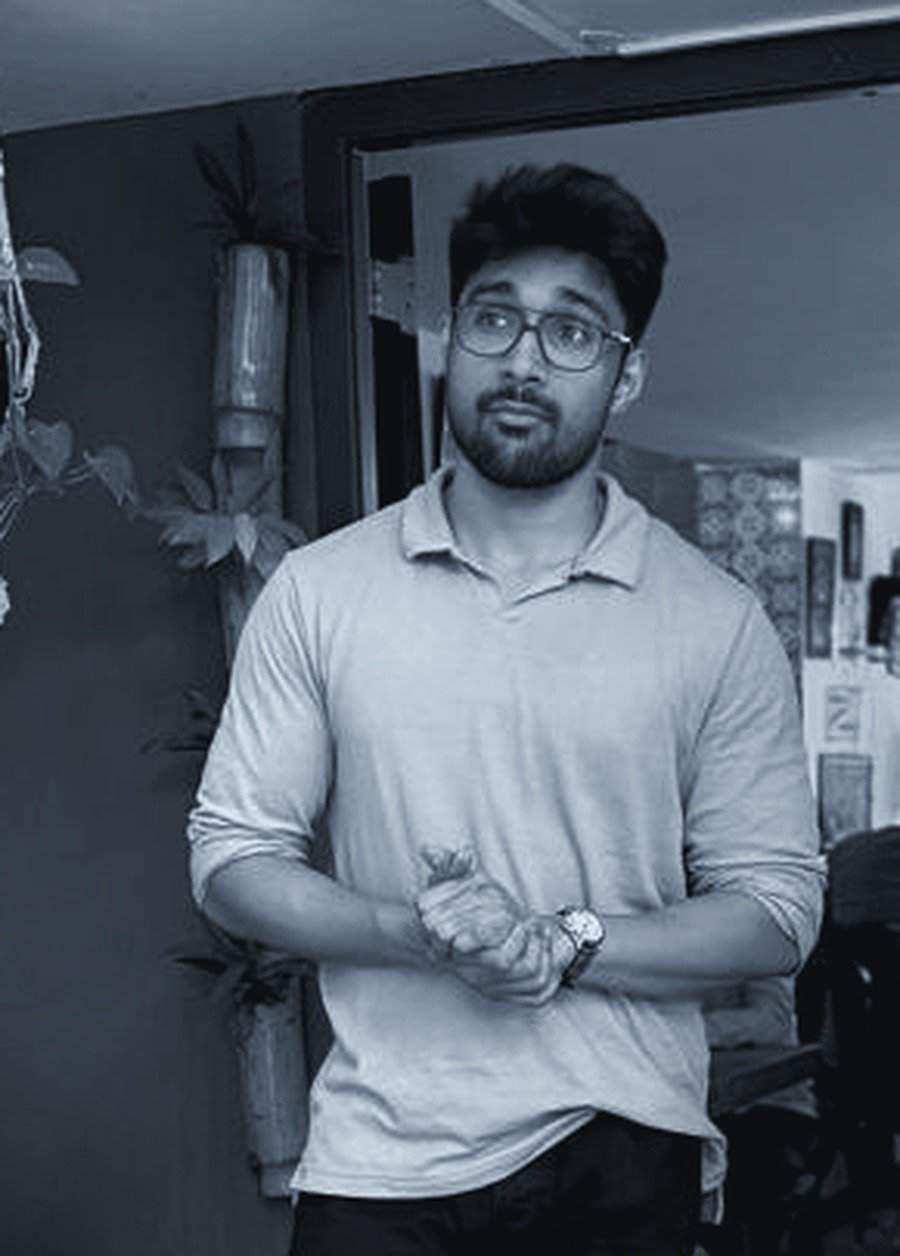
Most of my job starts after the demo ends. I'm Subhro — a backend and infrastructure engineer in Bengaluru, working across Terraform, Consul, and the backend systems underneath them: the unglamorous layer that decides whether an app survives production, not just a demo day.
I'm a Senior Software Engineer at IBM (via the HashiCorp acquisition), working across Terraform Cloud, Consul, and the backend systems underneath them — debugging, hardening, and speeding up the infrastructure that companies run their deployments on.
Before that I built backend systems and payment infrastructure at First Livingspaces, optimised Terraform pipelines at Tutero, and shipped platform integrations at BLKBOX. Across all of it, the common thread is the same: find the slow, fragile, or manual part of a system and make it fast, safe, and boring.
I studied Computer Science (B.Tech) at the University of Engineering and Management, Kolkata. Outside of work, I split my time between a PPL lifting split, boxing, and slowly building out a bobber-style motorcycle project.
A few of the problems behind the resume bullets — what was broken, what I built, and what changed.
Enterprise customers on Terraform Cloud and Enterprise — Bank of America among them — were hitting policy evaluations that took minutes, on every single run. I built a private OPA-based policy evaluation engine to replace the stock binary, then added project-, workspace-, and tag-level exclusions so teams could scope policy sets precisely instead of applying them blanket-wide.
After the HashiCorp acquisition, our internal async docs and comms tool, Hermes, needed to move off Google's stack and onto Microsoft's. I led the migration and built a SharePoint plugin for RFCs and PRDs, so engineers and EMs onboarding into the new org didn't lose the doc workflows they relied on.
Ziki and Yukio each needed payment processing, and neither team wanted to own two separate implementations. I designed a fullstack payment system that now handles 100% of transactions across both apps, then led a small team building four internal systems on top of it that improved day-to-day operations for 100+ users.
Every backend microservice had its own way of logging, which meant debugging a single request meant jumping between inconsistent formats and half-written trace statements. I designed a centralized log and trace system across all of them, so a single request could be followed end-to-end without anyone writing one-off instrumentation code again.
Tutero's per-microservice deployments took 30 minutes each, which meant every deploy was a coffee break. I rewrote the Terraform codebase behind it and wired the result into CI/CD, so the same deploy that used to be a interruption became something nobody had to think about.
Outside of work I'm building a game engine in Rust called Aloy. The part I'm proudest of is the event system: rather than force every event through one model, it runs a dispatcher for time-critical events (the equivalent of a Ctrl+C abort signal) alongside an async event queue built on MPSC channels for everything that can wait a cycle — so priority and throughput aren't fighting each other.
The tools I reach for, grouped by the kind of problem they solve.
Node.js, Go, Rust, Ruby on Rails, Java, Python. I pick the language the problem calls for, not the one that's most comfortable.
Terraform, Terraform Cloud & Enterprise, Sentinel, Kubernetes, Docker, CI/CD — the parts of shipping code that decide whether it survives production.
React.js and Ember.js — enough frontend to ship a feature end-to-end without waiting on someone else to wire up the UI.
PostgreSQL and Elasticsearch, plus centralized logging and distributed tracing across microservices in production.
In order, most recent first.
Terraform Cloud & Enterprise policy engineering
Payments & backend for Ziki, Yukio, and Sirrus
Deployment infrastructure & product engineering
Backend systems & platform integrations
Bachelor of Technology, Computer Science
Physics, Chemistry, Mathematics
"Subhro is dedicated and a fast learner. He managed his studies and work well throughout college, and is a genuinely good team member and software developer."
"Subhro is driven, knowledgeable, and articulate — always eager to pick up new languages. He's focused and full of potential, and it was no surprise when he landed his first job in his third year of B.Tech."
"We worked together on a project team. I'd recommend his expertise to anyone looking for a strong engineer — his ability to work through any problem is remarkable."
"Subhro is creative, skilled, and communicates well. He's self-motivated, goal-oriented, and always ready to help others — a great colleague to work with."
Open to Senior and Staff engineering roles, especially backend, infrastructure, and platform teams. Reach out directly — I reply fast.